Stolen.
By his own admission, then Vice President Joe Biden used
upwards of $1 billion of US government loan guarantees in
a bribery coercion scheme to threaten the Ukraine president
to immediately terminate the Prosecutor General who was investigating the corrupt practices of Burisma Holdings, as
well as the involvement of board director Hunter Biden.
This criminal act constitutes a federal felony crime and
disqualifies Biden from holding public office.
All the hard evidence and applicable laws follow in this straightforward legal analysis.
Federal Corrupt Practices Act
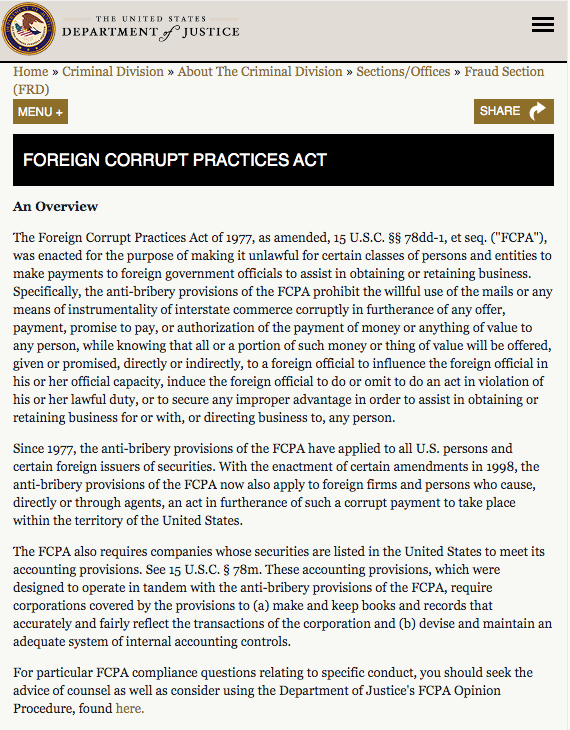
Now, here is the relevant section from the FOREIGN CORRUPT PRACTICES ACT, that is codified as United States Federal Law, which strictly “prohibits U.S. citizens and entities from bribing foreign government officials to benefit their business interests”.
U.S. Department of Justice Guidance
Furthermore, the U.S. Department of Justice has published “An Overview” which spells out that what VP Joe Biden did by threatening to withhold loan guarantees to the Ukraine was in blatant violation of U.S. Federal Law.
The Fraud Section of the Criminal Division of the DoJ makes it clear what constitutes a violation of the FOREIGN CORRUPT PRACTICES ACT as follows.
Concealment of Vice President Joe Biden’s senatorial records
There’s one more serious transgression of federal law that Joe Biden is guilty of: the deliberate concealment of his senatorial records. Those records are currently housed at the University of Delaware and Biden himself can permit their release.
In this particular regard, Biden’s refusal to release those public records is a brazen violation of 18 U.S. Code § 2071 which concerns the “Concealment, removal, or mutilation generally” of government records, documents, files, etc. The letter of the law can be read in the following screen capture taken from the Cornell Law School website. The disqualification clause is highlighted in blue.
18 U.S.C. § 201: Bribery of public officials and witnesses
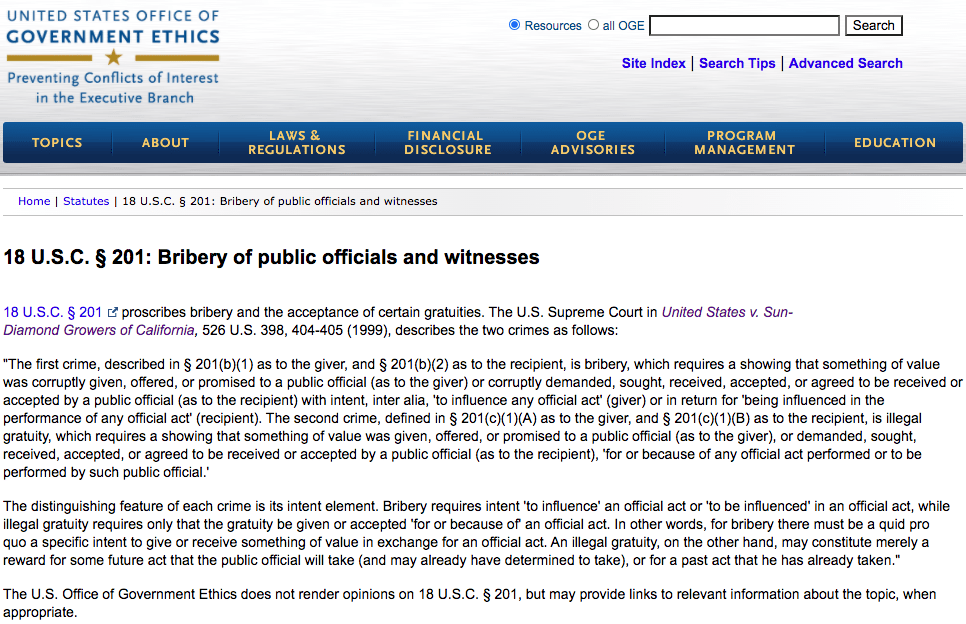
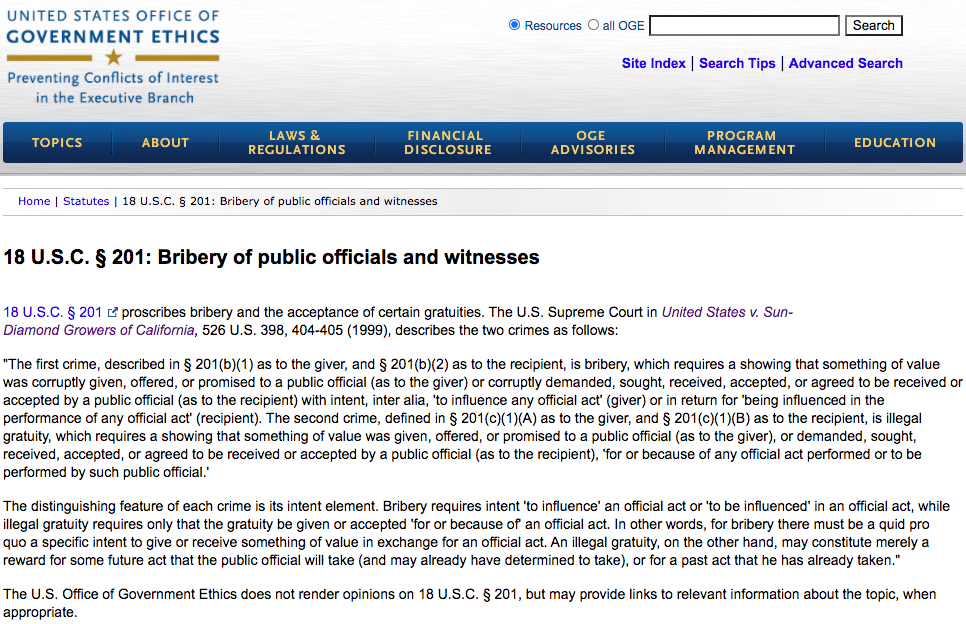
Then there is the federal statute codified by the U.S. Code concerning the “Bribery of public officials and witnesses”. Here again Vice President Biden clearly acted in contravention of both 18 U.S.C. § 201(b)(1) as to the giver, and § 201(b)(2) as to the recipient, in the crime of bribery of a pubic official.
18 U.S.C. § 201 proscribes bribery and the acceptance of certain gratuities. The U.S. Supreme Court in United States v. Sun-Diamond Growers of California, 526 U.S. 398, 404-405 (1999), describes the two crimes as follows:
“The first crime, described in § 201(b)(1) as to the giver, and § 201(b)(2) as to the recipient, is bribery, which requires a showing that something of value was corruptly given, offered, or promised to a public official (as to the giver) or corruptly demanded, sought, received, accepted, or agreed to be received or accepted by a public official (as to the recipient) with intent, inter alia, ‘to influence any official act’ (giver) or in return for ‘being influenced in the performance of any official act’ (recipient). The second crime, defined in § 201(c)(1)(A) as to the giver, and § 201(c)(1)(B) as to the recipient, is illegal gratuity, which requires a showing that something of value was given, offered, or promised to a public official (as to the giver), or demanded, sought, received, accepted, or agreed to be received or accepted by a public official (as to the recipient), ‘for or because of any official act performed or to be performed by such public official.’
The distinguishing feature of each crime is its intent element. Bribery requires intent ‘to influence’ an official act or ‘to be influenced’ in an official act, while illegal gratuity requires only that the gratuity be given or accepted ‘for or because of’ an official act. In other words, for bribery there must be a quid pro quo a specific intent to give or receive something of value in exchange for an official act. An illegal gratuity, on the other hand, may constitute merely a reward for some future act that the public official will take (and may already have determined to take), or for a past act that he has already taken.”
The U.S. Office of Government Ethics does not render opinions on 18 U.S.C. § 201, but may provide links to relevant information about the topic, when appropriate.
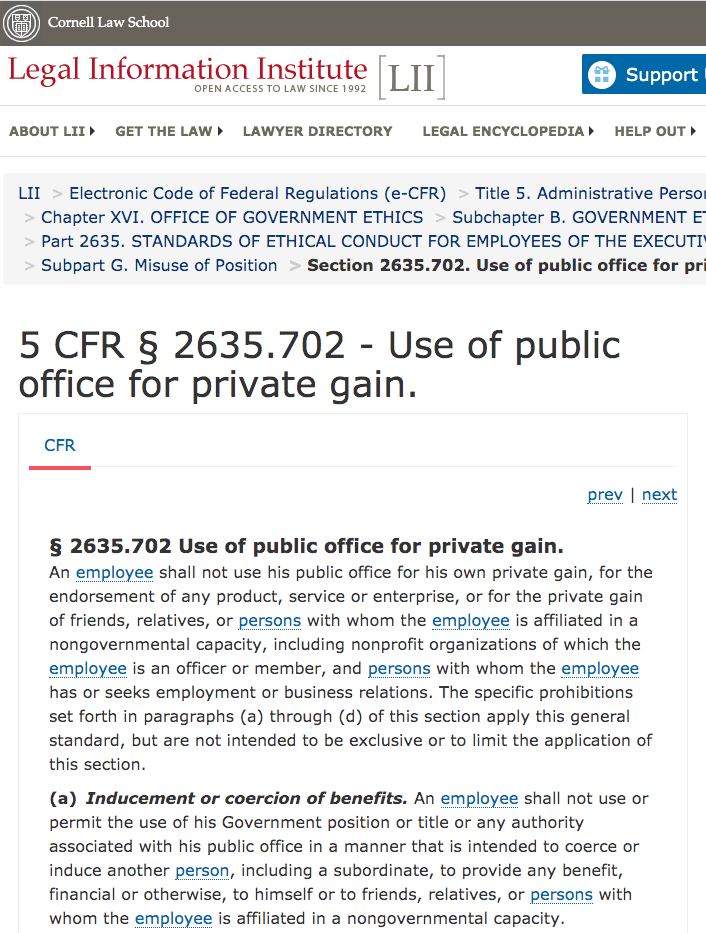
The screenshot posted below was taken from: Cornell Law School/The Legal Information Institute.
 TCO Intelligence Group